Saturday, May 31, 2025

New Deal Accomplishment: Millions of acres and thousands of miles landscaped


Above: From the Emergency Work Relief Program of the FERA, April 1, 1934 - July 1, 1935.


Above: WPA workers landscaped Roger Williams Park in Providence, Rhode Island. Photo from the National Archives.

New Deal Landscaping Made America Beautiful

It's difficult, and perhaps even impossible to measure the exact amount of landscaping the various New Deal agencies performed because it was measured alternately in acreage and linear miles (and the latter cannot be transferred into the former), and sometimes measured with little precision at all. 

Nevertheless, by examining final reports of several New Deal agencies we can at least get a general idea of the scope and magnitude of the New Deal landscaping projects.

The Work Division of the Federal Emergency Relief Administration landscaped "over a million acres of public grounds" (see first photo above). The WPA landscaped 211,240 acres of land (not including parks and roads) and 58,209 miles of roadside areas. The CCC reported landscaping on 233,793 acres, but this number is probably based on a restrictive definition of landscaping, given the CCC's enormous volume of work in soil conservation and tree planting. Workers in the National Youth Administration landscaped and beautified 12,380 miles of roadside areas.

The Civil Works Administration (CWA, a forerunner to the WPA), engaged in a lot of landscaping too, but the total acreage or miles is difficult to ascertain. It must have been massive however, since the CWA employed over 4 million jobless Americans and since roadwork, parks, and general landscaping were part of the bread & butter of what they did (see, e.g., Analysis of Civil Works Programs Statistics (1939), pp. 10-11.

At the very least, we can confidently say that the New Deal landscaped millions of acres and thousands of miles of land. America was beautified by this common good.

"Landscaping is one of the most cost effective tools for improving and sustaining the quality of life, whether in the city, the suburbs, or the country."

--Diane Relf, "The Value of Landscaping," Virginia Cooperative Extension, September 23, 2022

Thursday, May 22, 2025

New Deal Accomplishment: Over 32 million WPA housekeeping visits, many to the chronically ill


Above: A WPA Housekeeping Aid helps care for a newborn "in a rural home near Brewton, Alabama," April 1939. Photo and quote from the National Archives.


Above: A WPA Housekeeping Aid prepares lunch for two brothers from a low-income family in Washington, DC, August 1938. Photo from the National Archives.


Above: A WPA Housekeeping Aid "teaches a small boy living in a three-room cabin, half a mile up the side of a hill, the correct way to brush his teeth," Catlettsburg, Kentucky, June 1938. Photo and quote from the National Archives.


Above: A young mother receives hairstyling assistance from a WPA Housekeeping Aid, in Brighton, Massachusetts, between 1935 and 1943. The common good can make people smile! Photo from the National Archives.

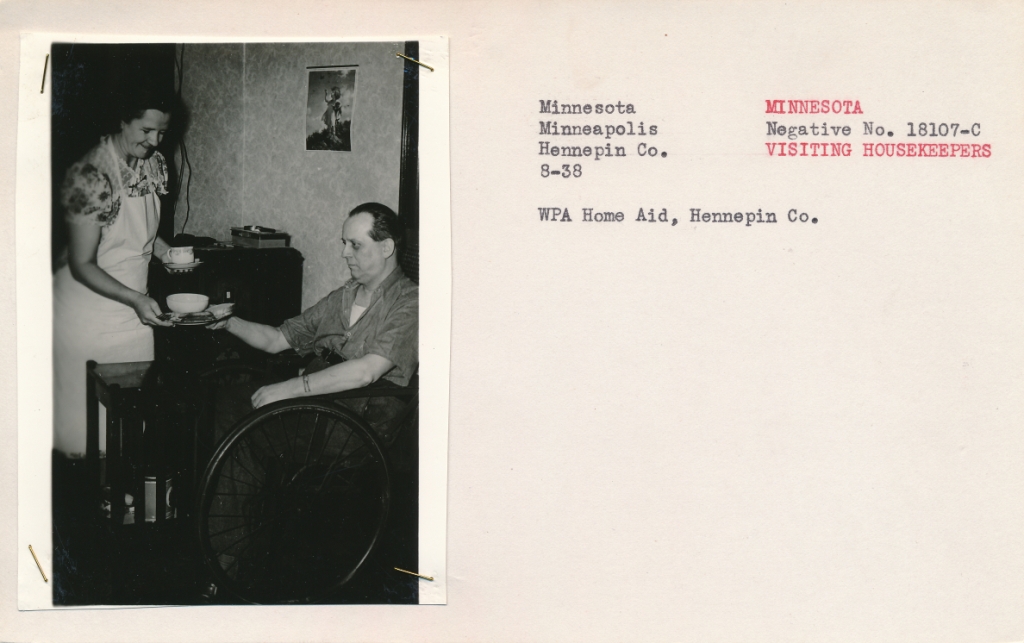
Above: A WPA Housekeeping Aid serves a meal to a Minnesotan in need of a helping hand, August 1938. Photo from the National Archives.


Above: A WPA Housekeeping Aid provides comfort to an elderly and "incurably ill" woman in Louisiana, between 1935 and 1943. "The husband is so crippled with rheumatism he can not do the housework though he gets part of the meals and cares for his wife at night. The housekeeper gives some time each day." Photo and quotes from the National Archives.

Over 32 million acts of human decency

Between 1935 and 1943, formerly unemployed women, now working in the WPA Housekeeping Aid program, made over 32 million visits to individuals and families in need. Other New Deal programs provided such assistance too. For example, thousands of women employed in the Work Division of the Federal Emergency Relief Administration made housekeeping visits to tens of thousands of families.

The women who worked in the WPA Housekeeping Aid program performed a number of chores, including: house cleaning; washing clothes; childcare; hygiene assistance; taking patients to medical appointments; reading to them; helping them go for walks; and preparing and serving meals.

The New Deal's housekeeping aid program was considered a groundbreaking development for the care of the chronically ill in their own homes (however, the program's services were not limited to the chronically ill). Clients often suffered from neurological diseases, arthritis, cancer, cataract-induced blindness, dementia, and other problems that still plague us today. (See, for example, Mary C. Jarrett, Housekeeping Service For Home Care of Chronic Patients: Report of a WPA Project in New York City, October, 1935 to July, 1938 (1938).

According to a 2023 report from the Home Care Association of America: "The workforce shortage in home-based care has reached crisis proportions. Despite the best efforts of industry leadership and management, the gap between the numbers of patients and families seeking assistance and the availability of workers to provide that care is accelerating at an unsustainable pace."

Perhaps the New Deal's innovative Housekeeping Aid program--its administration, funding, employment, training, and practices--can be informative, as we seek solutions to our present critical needs.

Saturday, May 17, 2025

New Deal Accomplishment: Over 4,400 Murals


Above: A mural created by WPA artist Gustave Dalstrom, between 1935 and 1943, at the Laurel School kindergarten, Wilmette, Illinois. Photo from the National Archives.


Above: A WPA mural to boost the spirits of kids convalescing at the Children's Hospital in Portland, Maine, 1936. Photo from the National Archives.


Above: A WPA poster, promoting an exhibit of mural studies. Poster created between 1936 and 1937. Image from the Library of Congress.


Above: "Arrival of First Train in Herrington – 1885," a mural study for the post office building in Herrington, Kansas, created by Harry Louis Freund while he was in the New Deal's Section of Painting and Sculpture, ca. 1937. Image from the Smithsonian American Art Museum.

4,400+ Murals

The New Deal sought to beautify America, tell its history, and cheer-up, educate, or inspire its people with numerous works of art, for example, murals placed in schools, hospitals, post offices, and other public buildings. Using reports from the respective agencies (most of which are on the Living New Deal's website, here) we find that artists in the Public Works of Art Project created 706 murals; in the Treasury Section of Painting and Sculpture (later named "Section of Fine Arts"), 1,047; in the WPA, 2,566; and in the Treasury Relief Art Project, 89.

This gives us a total of 4,408. But this is a conservative number. For example, I have not counted the 428 murals created by artists funded by the Work Division of the Federal Emergency Relief Administration (1934-1935) because some percentage of these--large or small we may never know--were completions of murals begun under the Public Works of Art Project.

Many of the New Deal's 4,400+ murals still exist today, still catching eyes, creating smiles, and telling the story of America.

Monday, May 5, 2025

New Deal Accomplishment: Over 4 million tons of food distributed to millions of Americans in need


Above: Federal surplus commodities being delivered to residents of Huntingdon, Pennsylvania, in June 1941. Photo by Edwin Rosskam, Farm Security Administration, courtesy of the Library of Congress.

4 Million+ Tons of Food

The New Deal set up the Federal Surplus Relief Corporation (FSRC) in 1933 to purchase excess farm products (food, livestock, and goods) and then distribute them at no cost to low-income Americans. At the time, farms across the nation were producing too much and driving costs down to the point where many farmers couldn't make a living. Buying excess, and then distributing it to those in need--people who weren't able to purchase much from the private sector and, in many cases, suffering from malnutrition--solved two problems simultaneously. In 1935, the FSRC was renamed "Federal Surplus Commodities Corporation" (FSCC), and then the FSCC was merged into the "Surplus Market Administration" (SMA) in June 1940. (See the Living New Deal's summary of the FSCC.)

Using the annual reports of these agencies--FY 1938, pp. 18-19 (summarizing 1933-1938); FY, 1939, p. 11; FY 1940, p. 8; and 1941, p. 22--we see that the New Deal purchased from farmers, and then distributed to millions of Americans in need, over 4 million tons of food (or, 8 billion pounds). And this is a very conservative estimate, because I have not included many items that are hard to calculate the weight of, for example, 2,558,695 cases of grapefruit (1938 report, p. 18). Additionally, the 4 million tons does not include food distributed to schools for their lunch programs or foods purchased via the FSCC's "Food Stamp Plan" (initiated in 1939). In other words, the New Deal's overall food initiative greatly exceeded 4 million tons.

Foods purchased and distributed by the New Deal included fresh apples, butter, cheese, eggs, fish, milk, onions, sweet potatoes, white potatoes, prunes, and smoked pork.

The purchase and free distribution of excess food is one of the New Deal's greatest uses of the "General Welfare" sections of the U.S. Constitution (Preamble and Article I, Section 8).

Sunday, April 27, 2025

New Deal Accomplishment: 800 electric cooperatives, serving 40 million Americans


Above: A Rural Electrification Administration (REA) poster. From the U.S. Department of Agriculture.

The Enduring Legacy of the Rural America & New Deal Electric Partnership

President Franklin Roosevelt signed the Rural Electrification Act into law on May 20, 1936, in order to finance utility projects in under-served areas. Private business had no interest in providing electricity to these rural areas, so U.S. Senator George Norris (R-Neb.) propelled the electrification bill through Congress and onto FDR's desk. Rural Americans then created electric cooperatives, borrowed money from the recently-created Rural Electrification Administration (REA), at low interest, and built their own electric plants and installed poles, lines, and connections.  

By the end of 1943, as the core of the New Deal years disappeared in the shadow of World War II, the REA had provided loans to 805 electric cooperatives, serving over 1 million Americans. Fortunately, the REA was one of the New Deal programs that survived the war, and it continued to grow. By the end of 1951, for example, it had provided loans to 1,009 cooperatives, serving 3.5 million people. (Statistics from Rural Lines: The Story of the Rural Electrification Administration's First Twenty-five Years, 1935-1960, p. 55.)

When the 1936 electrification act was signed, about 90% of rural homes had no electricity. Less than 20 years later, 1953, that statistic was beginning to reverse, for example, "more than 90 percent of U.S. farms had electricity" ("History," National Rural Electric Cooperative Association (NRECA), both emphases added).

Today, there are over 800 cooperatives (some of the original cooperatives have merged with others) and they serve over 40 million Americans ("Electric Co-op Facts & Figures," NRECA). Importantly, "Most rural electrification is the product of locally owned rural electric cooperatives that got their start by borrowing funds from REA to build lines and provide service on a not-for-profit basis ("History," NRECA, emphasis added).

In numerous books and websites, many electric cooperatives proudly celebrate their FDR and REA origins.

Friday, April 25, 2025

New Deal Accomplishment: 2.5 billion trees planted


Above: The description for this ca. 1938 photograph reads: "Planting crews in action near Dunlap [Texas] shown at work in the general type of country in which plantings of shelter belts of trees, against wind erosion, are being made by relief workers - many of them farmers employed on the U.S. Forest Service-WPA Prairie States Forestry Project. About 500 WPA workers were so employed in northwest Texas alone in 1938. Similar work is in progress in other prairie states of the region west of the Mississippi River." Photo from the National Archives.

Above: The description for this photo, also ca. 1938, reads: "Two-year-old shelterbelt near Memphis [Texas], planted by relief workers employed under the U.S. Forest Service-WPA Prairie States Forestry Project. Center rows of cottonwood flanked by Chinese elm, honey locust and Osage orange. The man shown in the picture is standing between the honey locust rows." Photo from the National Archives.


Above: A CCC camp and tree nursery near Parsons, West Virginia, ca. 1936. Photo from the Library of Congress.


Above: The description for this photograph reads: "These N.Y.A. youths at the Lassen Forestry Project in Susanville, Calif., are tying up young trees into protective wrapping for distribution to famous California forests." Photo from the National Archives.


Above: The CCC planted many trees at Green Ridge State Forest, Maryland. How many of them still stand today? And how many CCC trees continue to stand all across the country? And how many younger trees today were propagated by those New Deal trees? Photo by Brent McKee, 2011.


Above: FDR noted that "while only God can make a tree, we have to do a little bit to help ourselves" ("Remarks at Clarksburg, West Virginia, October 29, 1944," American Presidency Project, University of California Santa Barbara. WPA poster, courtesy of the Library of Congress.

2.5 Billion Trees Planted

Between 1933 and 1942, the Civilian Conservation Corps (CCC) planted over 2.3 billion trees; the Federal Emergency Relief Administration (FERA), 5.7 million; the Works Progress Administration (WPA), 177 million; and the National Youth Administration (NYA), over 19 million trees (and shrubs) (statistics from the agencies' final reports). 

Other New Deal programs planted trees too--for example, the Civil Works Administration (CWA) planted thousands in Berkeley, California ("CWA To Plant More Trees," Oakland Tribune, February 21, 1934, p. 6)--but these nationwide totals can be harder to come by.

All in all though, we can safely say that the New Deal planted about 2.5 billion trees.