Saturday, May 31, 2025

New Deal Accomplishment: Millions of acres and thousands of miles landscaped


Above: From the Emergency Work Relief Program of the FERA, April 1, 1934 - July 1, 1935.


Above: WPA workers landscaped Roger Williams Park in Providence, Rhode Island. Photo from the National Archives.

New Deal Landscaping Made America Beautiful

It's difficult, and perhaps even impossible to measure the exact amount of landscaping the various New Deal agencies performed because it was measured alternately in acreage and linear miles (and the latter cannot be transferred into the former), and sometimes measured with little precision at all. 

Nevertheless, by examining final reports of several New Deal agencies we can at least get a general idea of the scope and magnitude of the New Deal landscaping projects.

The Work Division of the Federal Emergency Relief Administration landscaped "over a million acres of public grounds" (see first photo above). The WPA landscaped 211,240 acres of land (not including parks and roads) and 58,209 miles of roadside areas. The CCC reported landscaping on 233,793 acres, but this number is probably based on a restrictive definition of landscaping, given the CCC's enormous volume of work in soil conservation and tree planting. Workers in the National Youth Administration landscaped and beautified 12,380 miles of roadside areas.

The Civil Works Administration (CWA, a forerunner to the WPA), engaged in a lot of landscaping too, but the total acreage or miles is difficult to ascertain. It must have been massive however, since the CWA employed over 4 million jobless Americans and since roadwork, parks, and general landscaping were part of the bread & butter of what they did (see, e.g., Analysis of Civil Works Programs Statistics (1939), pp. 10-11.

At the very least, we can confidently say that the New Deal landscaped millions of acres and thousands of miles of land. America was beautified by this common good.

"Landscaping is one of the most cost effective tools for improving and sustaining the quality of life, whether in the city, the suburbs, or the country."

--Diane Relf, "The Value of Landscaping," Virginia Cooperative Extension, September 23, 2022

Thursday, May 22, 2025

New Deal Accomplishment: Over 32 million WPA housekeeping visits, many to the chronically ill


Above: A WPA Housekeeping Aid helps care for a newborn "in a rural home near Brewton, Alabama," April 1939. Photo and quote from the National Archives.


Above: A WPA Housekeeping Aid prepares lunch for two brothers from a low-income family in Washington, DC, August 1938. Photo from the National Archives.


Above: A WPA Housekeeping Aid "teaches a small boy living in a three-room cabin, half a mile up the side of a hill, the correct way to brush his teeth," Catlettsburg, Kentucky, June 1938. Photo and quote from the National Archives.


Above: A young mother receives hairstyling assistance from a WPA Housekeeping Aid, in Brighton, Massachusetts, between 1935 and 1943. The common good can make people smile! Photo from the National Archives.

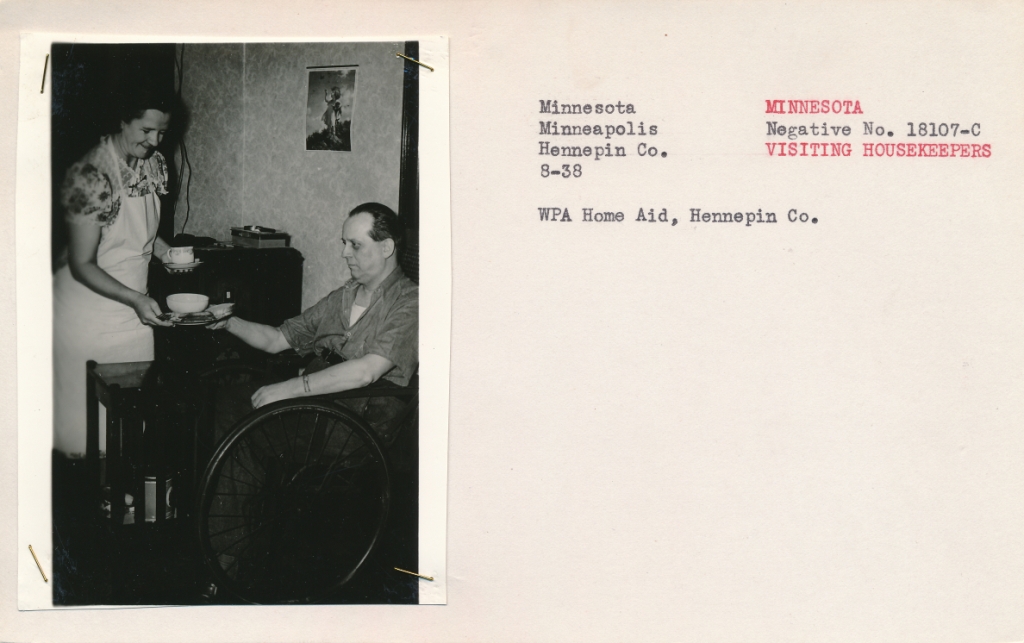
Above: A WPA Housekeeping Aid serves a meal to a Minnesotan in need of a helping hand, August 1938. Photo from the National Archives.


Above: A WPA Housekeeping Aid provides comfort to an elderly and "incurably ill" woman in Louisiana, between 1935 and 1943. "The husband is so crippled with rheumatism he can not do the housework though he gets part of the meals and cares for his wife at night. The housekeeper gives some time each day." Photo and quotes from the National Archives.

Over 32 million acts of human decency

Between 1935 and 1943, formerly unemployed women, now working in the WPA Housekeeping Aid program, made over 32 million visits to individuals and families in need. Other New Deal programs provided such assistance too. For example, thousands of women employed in the Work Division of the Federal Emergency Relief Administration made housekeeping visits to tens of thousands of families.

The women who worked in the WPA Housekeeping Aid program performed a number of chores, including: house cleaning; washing clothes; childcare; hygiene assistance; taking patients to medical appointments; reading to them; helping them go for walks; and preparing and serving meals.

The New Deal's housekeeping aid program was considered a groundbreaking development for the care of the chronically ill in their own homes (however, the program's services were not limited to the chronically ill). Clients often suffered from neurological diseases, arthritis, cancer, cataract-induced blindness, dementia, and other problems that still plague us today. (See, for example, Mary C. Jarrett, Housekeeping Service For Home Care of Chronic Patients: Report of a WPA Project in New York City, October, 1935 to July, 1938 (1938).

According to a 2023 report from the Home Care Association of America: "The workforce shortage in home-based care has reached crisis proportions. Despite the best efforts of industry leadership and management, the gap between the numbers of patients and families seeking assistance and the availability of workers to provide that care is accelerating at an unsustainable pace."

Perhaps the New Deal's innovative Housekeeping Aid program--its administration, funding, employment, training, and practices--can be informative, as we seek solutions to our present critical needs.

Saturday, May 17, 2025

New Deal Accomplishment: Over 4,400 Murals


Above: A mural created by WPA artist Gustave Dalstrom, between 1935 and 1943, at the Laurel School kindergarten, Wilmette, Illinois. Photo from the National Archives.


Above: A WPA mural to boost the spirits of kids convalescing at the Children's Hospital in Portland, Maine, 1936. Photo from the National Archives.


Above: A WPA poster, promoting an exhibit of mural studies. Poster created between 1936 and 1937. Image from the Library of Congress.


Above: "Arrival of First Train in Herrington – 1885," a mural study for the post office building in Herrington, Kansas, created by Harry Louis Freund while he was in the New Deal's Section of Painting and Sculpture, ca. 1937. Image from the Smithsonian American Art Museum.

4,400+ Murals

The New Deal sought to beautify America, tell its history, and cheer-up, educate, or inspire its people with numerous works of art, for example, murals placed in schools, hospitals, post offices, and other public buildings. Using reports from the respective agencies (most of which are on the Living New Deal's website, here) we find that artists in the Public Works of Art Project created 706 murals; in the Treasury Section of Painting and Sculpture (later named "Section of Fine Arts"), 1,047; in the WPA, 2,566; and in the Treasury Relief Art Project, 89.

This gives us a total of 4,408. But this is a conservative number. For example, I have not counted the 428 murals created by artists funded by the Work Division of the Federal Emergency Relief Administration (1934-1935) because some percentage of these--large or small we may never know--were completions of murals begun under the Public Works of Art Project.

Many of the New Deal's 4,400+ murals still exist today, still catching eyes, creating smiles, and telling the story of America.

Monday, May 5, 2025

New Deal Accomplishment: Over 4 million tons of food distributed to millions of Americans in need


Above: Federal surplus commodities being delivered to residents of Huntingdon, Pennsylvania, in June 1941. Photo by Edwin Rosskam, Farm Security Administration, courtesy of the Library of Congress.

4 Million+ Tons of Food

The New Deal set up the Federal Surplus Relief Corporation (FSRC) in 1933 to purchase excess farm products (food, livestock, and goods) and then distribute them at no cost to low-income Americans. At the time, farms across the nation were producing too much and driving costs down to the point where many farmers couldn't make a living. Buying excess, and then distributing it to those in need--people who weren't able to purchase much from the private sector and, in many cases, suffering from malnutrition--solved two problems simultaneously. In 1935, the FSRC was renamed "Federal Surplus Commodities Corporation" (FSCC), and then the FSCC was merged into the "Surplus Market Administration" (SMA) in June 1940. (See the Living New Deal's summary of the FSCC.)

Using the annual reports of these agencies--FY 1938, pp. 18-19 (summarizing 1933-1938); FY, 1939, p. 11; FY 1940, p. 8; and 1941, p. 22--we see that the New Deal purchased from farmers, and then distributed to millions of Americans in need, over 4 million tons of food (or, 8 billion pounds). And this is a very conservative estimate, because I have not included many items that are hard to calculate the weight of, for example, 2,558,695 cases of grapefruit (1938 report, p. 18). Additionally, the 4 million tons does not include food distributed to schools for their lunch programs or foods purchased via the FSCC's "Food Stamp Plan" (initiated in 1939). In other words, the New Deal's overall food initiative greatly exceeded 4 million tons.

Foods purchased and distributed by the New Deal included fresh apples, butter, cheese, eggs, fish, milk, onions, sweet potatoes, white potatoes, prunes, and smoked pork.

The purchase and free distribution of excess food is one of the New Deal's greatest uses of the "General Welfare" sections of the U.S. Constitution (Preamble and Article I, Section 8).